From software to hardware, from services to open source — a complete product matrix around AI atomic simulation for electrochemistry. Every delivery flows data back.
Autonomous AI research workbench · used daily by institutions
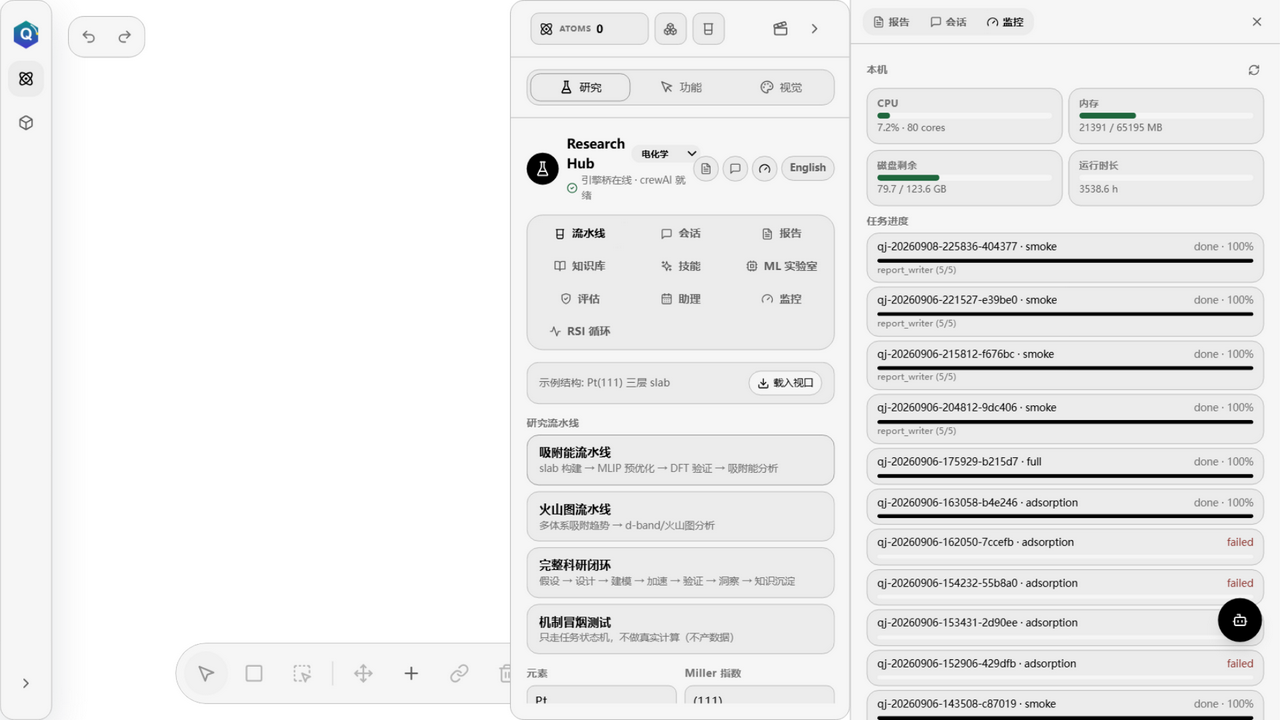
A 24/7 closed loop from hypothesis to academic report. A five-agent pipeline executes; RSI recursive self-improvement evolves — a real product, not a prototype.

Q-nergy Research Hub — real product UI (click to enlarge)
AI DFT computing agent (formerly SLISA) · open source on GitHub
A full-workflow agent for first-principles computation: five specialist agents in relay from system design to academic report; an RSI knowledge base archives experience automatically.
Understands the research goal and designs the system and surface plan: facet cutting, supercell construction, adsorption-site enumeration — translating science into computation.
Surface plan · task listRuns open-source machine-learning potentials (MACE / DPA-4) for high-throughput pre-screening, rapidly converging on the few systems worth refined calculation.
Ranked candidates · screening dataSubmits shortlisted systems to mainstream engines (CP2K / ABACUS) with SLURM cluster scheduling and automatic resume — no manual babysitting.
Converged structures · energies & forcesAdsorption energies, free-energy diagrams, volcano plots, density of states — multi-dimensional auto-plotting with physics sanity checks.
Figures · scaling relationsAssembles everything into an academic-grade report with full figures; experience rules are archived into the RSI knowledge base.
Academic report · RSI archiveFull report & figures from a CO₂RR high-entropy-alloy screening campaign — contact us for the complete sample.
Computing service platform · project-based delivery
A computing platform for research and industry teams: standardized requirement analysis, solution design and execution — compressing delivery from months to days.
Project & material system analysis
Route & parameters, confirmed together
MLIP pre-screening + mainstream engines
Multi-engine cross-validation, human review
Academic-grade report & full figures
Q&A support & optional iterations
5–10 day end-to-end delivery versus 6–12 months for traditional outsourcing.Final timeline upon consultation, depending on system size and workload.
Multi-engine cross-validation of result consistency with human review at key checkpoints; deliverables are ready for papers and proposals.
Battery material inverse-design workbench
An inverse-design environment for battery R&D: search candidate formulations backward from performance targets, across four linked 3D views covering molecules, crystals and process.
Q-Batt battery array · 16-channel digital-twin illustration
Automated electrochemistry platform · integrated hardware & software
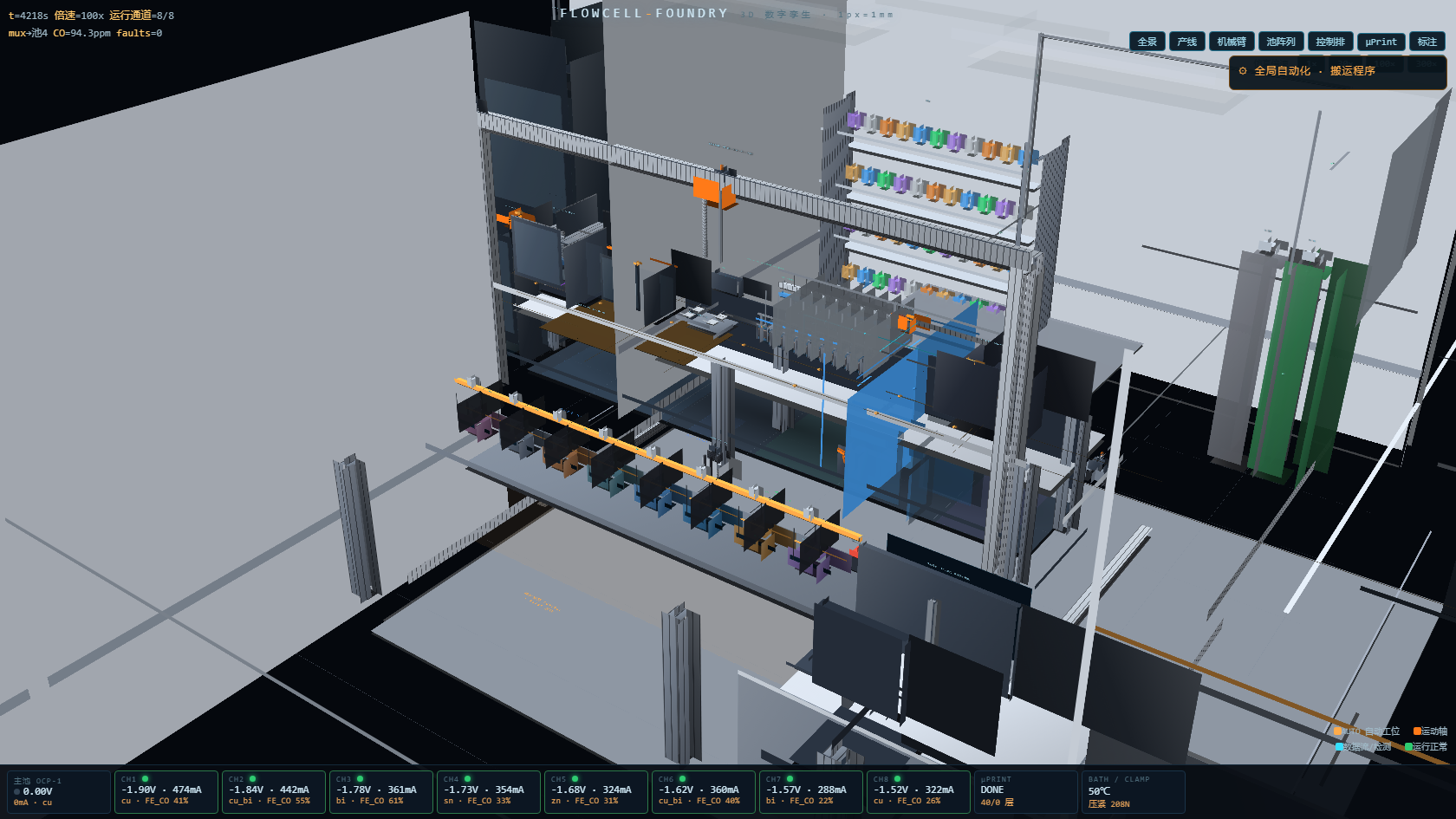
A modular, fully automated catalysis platform: 11 module classes on a single bus, drivable directly by AI agents — extending “AI designs materials” into “AI runs experiments”.
FLOWCELL-BUS · 3D digital-twin preview (click to enlarge)
Foundation-model framework for electrochemistry
A foundation-model framework built for electrochemistry: models that directly understand electrode interfaces, the electric double layer and the constant-potential world — a unified intelligent base for batteries, catalysis and clean-energy materials. Its scientific base, the DFT-free electronic-structure engine, is validated on 33 systems.
From an open-source agent to a commercial workbench, from computing services to automated hardware — tell us your R&D workflow and we’ll suggest a combination.