We are building the “AlphaFold” of electrochemistry — compressing the discovery of battery, catalysis and clean-energy materials from years down to days.
Not a concept demo — a productivity tool used daily by real institutional customers.
From an AI research workbench to automated hardware — every delivery flows data back, making the base stronger every day.
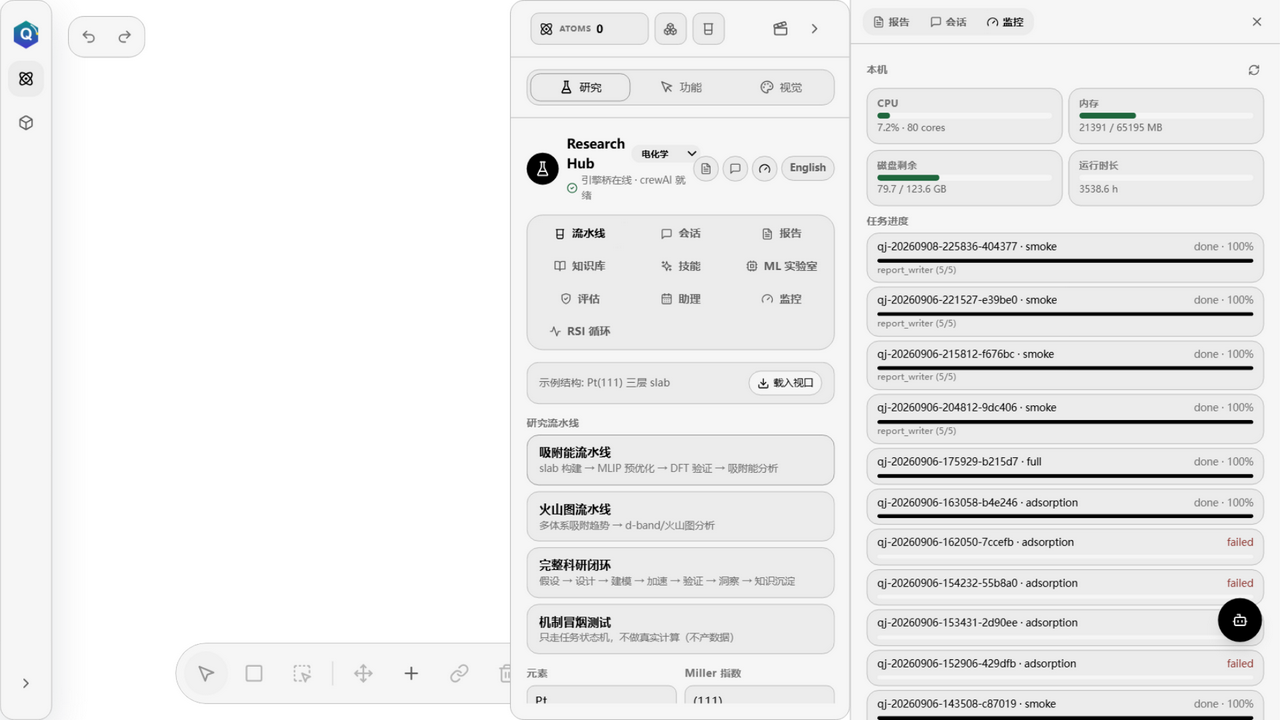
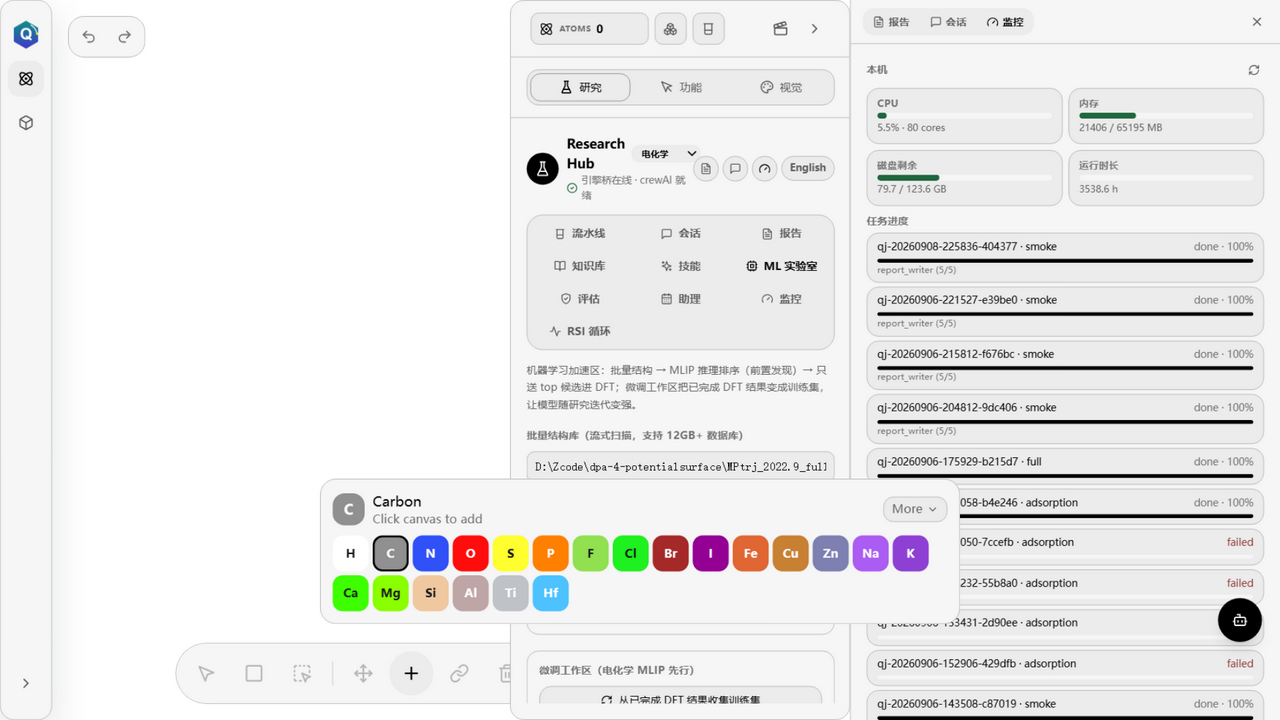
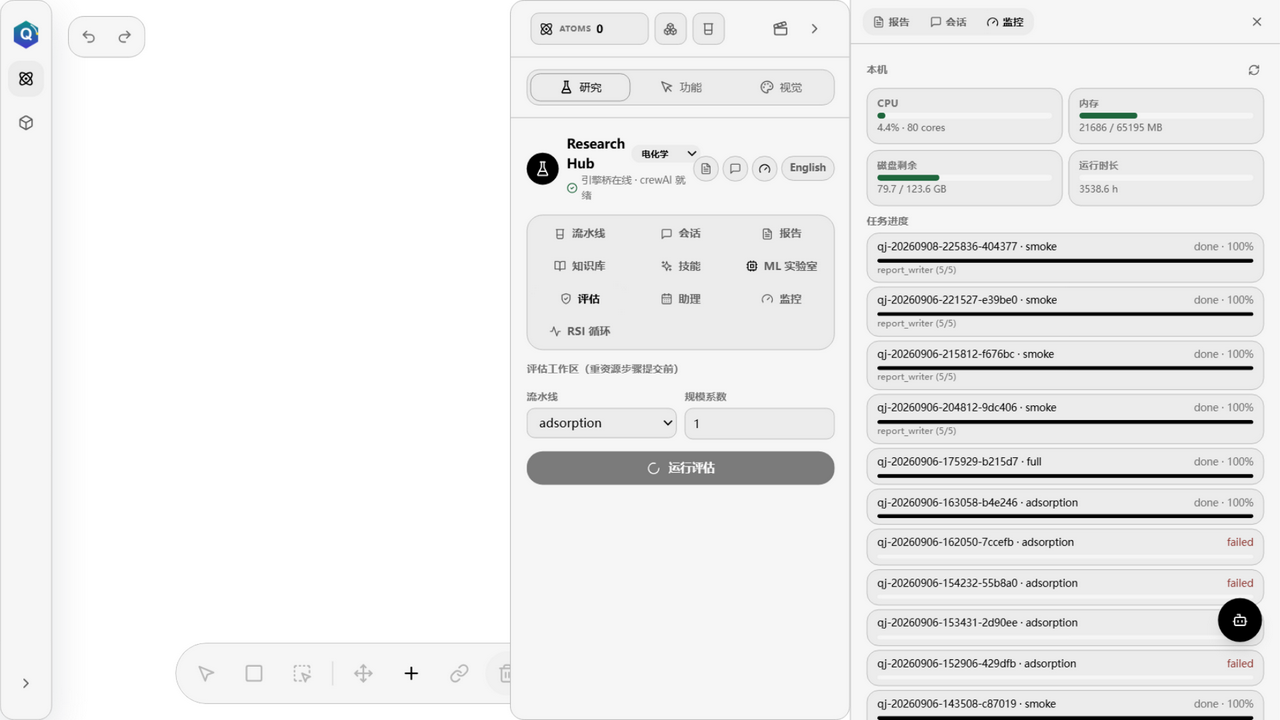
Hypothesis-to-report closed loop, 24/7: five-agent pipeline plus RSI recursive self-improvement; 12-tab Research Hub, 100+ 3D modeling panels, bilingual UI, Docker / desktop deployment — a real product used daily by institutions.
Learn more →Surface scientist → MLIP optimization → DFT engineering → analysis → report; three standard workflows.
Learn more →Molecule · crystal · Pareto · 16-channel FlowBench twin.
Learn more →11 module classes on one bus — AI agents drive lab hardware directly.
Learn more →Every five-agent session is visible in real time: tabs advance with execution stages, logs stream line by line, and the chart draws itself — fully transparent from system design to academic report.
Q-nergy live session illustration · agent relay executing automatically
Delivery measured in days versus 6–12 months for traditional outsourcing — an order-of-magnitude compression of R&D iteration cycles.
Computing services generate cash flow that funds foundation research — a technology route that doesn’t depend on external transfusions.
Every delivery automatically deposits structural and result data — customers fund the production of our foundation-model training set.
AI for Science is moving from Nobel prizes to industry — and electrochemistry is the largest untapped territory on the AI4S map.
DATA FLYWHEEL · EVERY DELIVERY MAKES THE BASE STRONGER
Open-source MLIPs (MACE / DPA-4) for high-throughput pre-screening, refined by mainstream engines such as CP2K / ABACUS — agents orchestrate cluster compute.
Five-agent relay pipeline with RSI recursive self-improvement: experience auto-archived, dual-ledger audited — the system gets sharper with use.
Electronic structure without the traditional DFT workflow — validated on 33 systems, paving the way to the electrochemistry foundation model.
View technology →Electrolyte formulation screening, interfacial film (SEI/CEI) mechanisms, electrode material modification.
High-entropy-alloy catalyst screening, adsorption scaling relations, batch volcano plots.
HER / OER catalyst design, constant-potential interface simulation, overpotential analysis.
Fast band-structure / DOS prediction for semiconductors, insulators and alloys, with inverse design.
(Selected partners)
Tell us your material system and goal — we return an assessment and computing plan within 48 hours.